September 18, 2026
A Museum for All: Assessing Accessibility with YPK Bali
.jpg)
By Marlowe Bandem
People experience museums in different ways. Small details determine whether visitors can move comfortably and understand the displays. A step may obstruct a wheelchair, a narrow passage may be difficult to navigate, and small text may be hard to read. Information available only as text or audio may also exclude visitors.
At SAKA Museum, world-class hospitality means making Bali’s timeless culture accessible and welcoming to as many people as possible. This responsibility carries particular weight for a museum named one of TIME’s World’s Greatest Places in 2024 and included in the Prix Versailles list of the World’s Most Beautiful
Museums in 2025. Such commitment came into focus during a recent visit by people with physical disabilities.
On Friday, 4 September 2026, SAKA welcomed a group from Yayasan Peduli Kemanusiaan Bali, or YPK Bali, led by its Chairperson, Elsye Suryawan. The visitors were Bibil, Bayu, and Putu, three young wheelchair users, and Wahyu, an adult visitor with limited mobility. They were accompanied by three members of the YPK Bali team.
YPK Bali brought years of experience to the visit. Founded in 2001, the non-profit organisation supports people with disabilities through physical rehabilitation, psychological and emotional support, informal education, and community-based services.
Connecting that experience with the museum was Emma Graciela, a student researcher from Udayana University who studies museum accessibility. Her interest is personal. “My late grandmother, whom we called Opung Boru in Batak, needed a walker and wheelchair towards the end of her life,” Emma said. “My family found it difficult to take her to museums because many lacked ramps, seating, and accessible toilets. As an archaeology student who loves museums, that experience led me to research accessibility.”
Emma’s research had already brought her to SAKA to measure circulation routes and display heights. This time, those measurements could be considered alongside the experiences of people moving through the museum themselves.
Following Curiosity Through the Museum
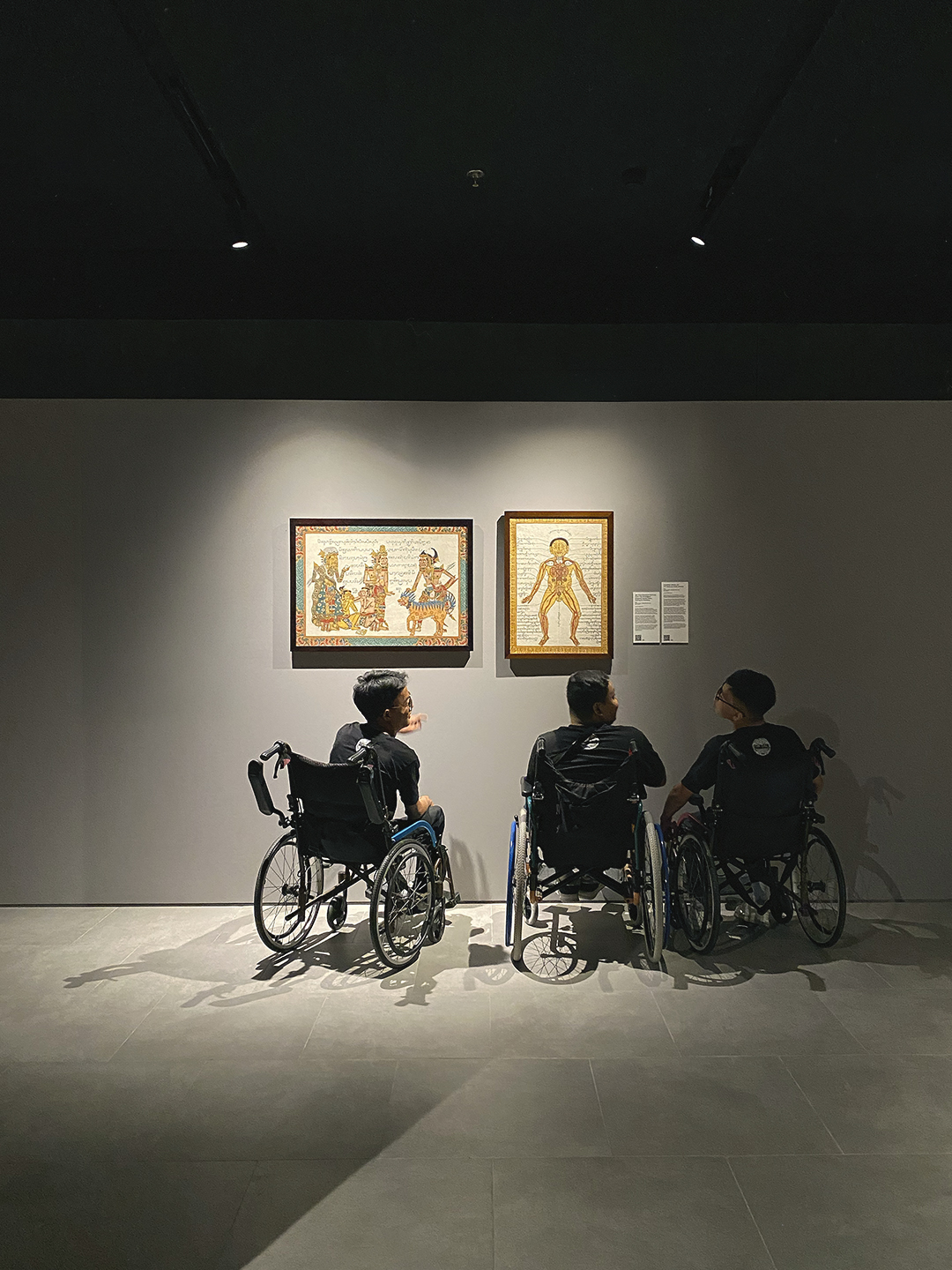
After Andika Devara Loeis, SAKA’s Education and Outreach Officer, welcomed the group, curiosity began to shape the route. At the Walidwipa painting, Bibil moved ahead, eager to reach the first stop. Participants pointed to different parts of Bali and called out places they’ve been and hoped to visit. Walidwipa became a mind map of journeys they wanted to make through the lenses of SAKA.
That curiosity soon carried Bibil towards the auditorium. The SAKA film and the museum’s ogoh-ogoh had been on his mind from the beginning. Since age ten, he has made miniature statues and shared his creations on TikTok.
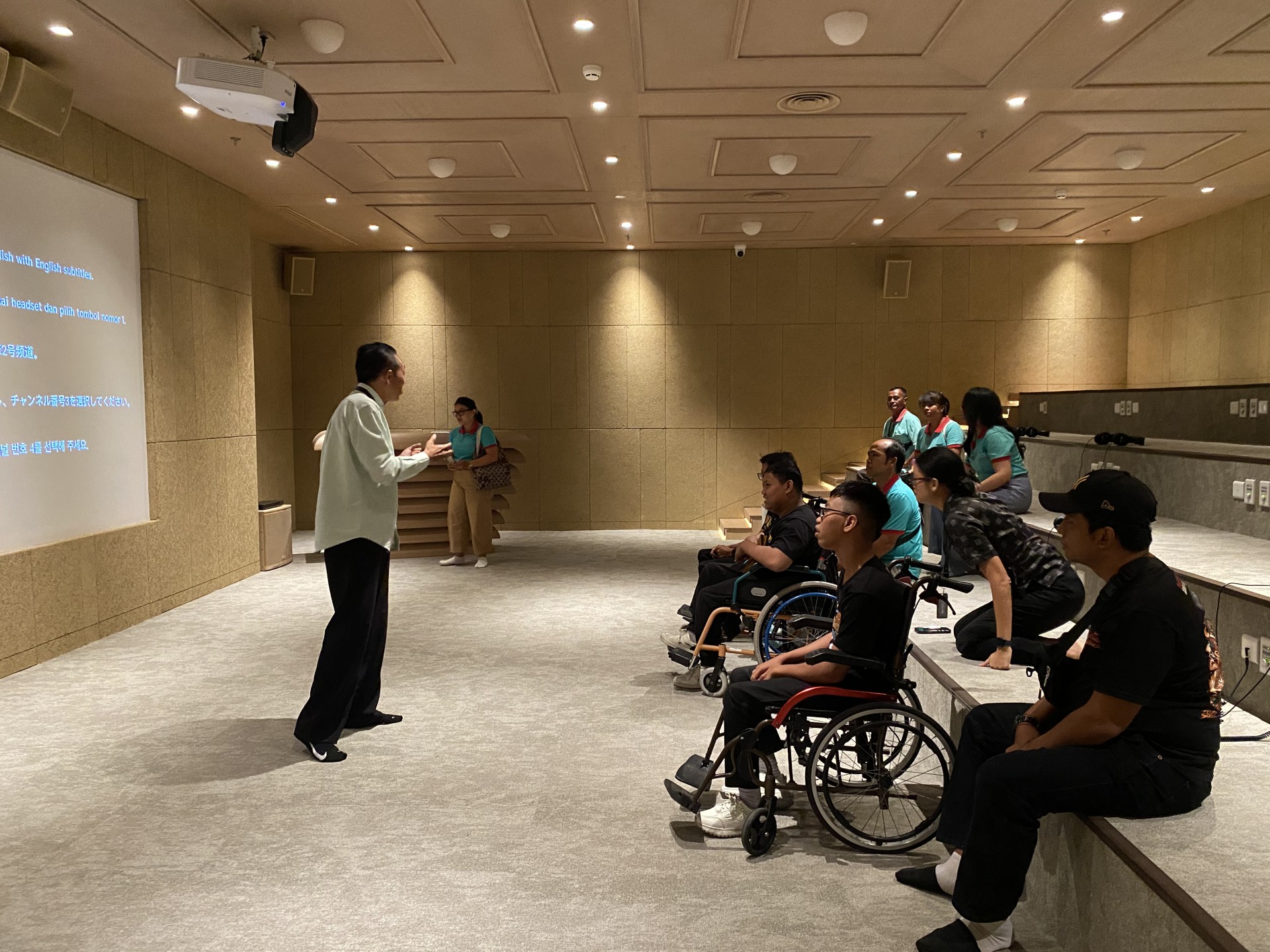
Inside the auditorium, Bibil, Bayu, and Putu watched from the front row as the film moved through Melasti, the making of ogoh-ogoh, Pengerupukan, and Nyepi. Aerial views showed activity across Bali giving way to the Balinese Day of Silence. The Indonesian soundtrack came through their headphones. When the lights returned, Bibil smiled broadly. For the friends, selecting the language and listening through headphones was a new experience.
From the film, the group moved into Subak: The Ancient Order of Bali. Exhibition Coordinator Vincent Chandra introduced subak as a system connecting water management, agriculture, ritual, and community life. Tactile elements and multimedia invited participation. Yet one digital display raised a practical question, could a visitor seated in a wheelchair operate it comfortably? Emma watched as we tested the design.
That question of reach continued in the Heritage Gallery. Objects connected with Panca Maha Bhuta: The Five Great Elements introduced Balinese understandings of the material and spiritual worlds. Here, the placement of objects and labels shaped how closely each visitor could engage. Wahyu moved slowly but surely from one display cabinet to the next, reading about each object’s origin, function, and cultural context.
.jpg)
Questions of access and interpretation followed the group into Kamasan: The Noble Tradition of Bali. Paintings by masters and younger artists traced the tradition from ritual settings to contemporary practice. Although a multilingual audio guide was available, the participants chose a live conversation with SAKA’s Advisor Marlowe Bandem. Their questions moved from the paintings to exhibition development.
The conversation gathered around an ider-ider nearly thirteen metres long. The painted ceremonial cloth, traditionally used as a temple hanging, depicts Mpu Tantular’s Sutasoma. Marlowe explained how it gave Indonesia the phrase Bhinneka Tunggal Ika. Asked what it meant, Bayu, Bibil, and Putu answered at once, “Unity in Diversity.” Their response echoed the visit as people with different ways of moving shared one cultural space.
As they answered, Wahyu leaned towards the nearby Visual System of Kamasan display. He followed the stages through which wong-wongan or puppet figures are drawn and coloured, studying their iconography, earth-toned palette, and gestures.
Wahyu’s attention shifted the conversation to the work behind an exhibition. Marlowe described how research, conservation, interpretation, education, and visitor experience come together. He also spoke about museum careers and how young people, including those with disabilities, can help care for and share culture.
From there, the group moved upstairs to the ogoh-ogoh in KASANGA. For Bibil, the towering figures brought the miniature form he knew to a new scale. The participants navigated the galleries largely on their own, moving among other visitors and choosing where to stop.
From KASANGA, they entered the dome for Twilight Journey. Daylight faded across the circular screen, night settled over different parts of Bali, and the island slowly entered twenty-four hours of silence. The images were no longer confined to a screen in front of the visitors. Serene scenery moved around them.
When Visitors Become Advisers
With the tour complete, the group gathered at the SAKA Knowledge Center with SAKA’s Visitor Engagement Manager Tantri Arihta Sitepu and Emma to discuss the day’s experience. The museum team listened as participants reflected on their arrival, movement between galleries, use of the lift and toilet, access to displays, and experience of the films.
The discussion began with favourite moments. Bibil remembered the film and headphones. Putu chose the giant effigies, while Bayu returned to the Kamasan paintings. Wahyu spoke about the seamless flow between exhibitions. The visit had not tired him; each gallery made him curious about what came next. Together, their choices showed how sound, scale, stories, objects, and conversation offer different paths into a museum.
“The most memorable moment for me was seeing people with disabilities enjoy SAKA with the same curiosity, enthusiasm, and joy as other visitors,” said Elsye Suryawan, Chairperson of YPK Bali. “It reminded me that the opportunity to enjoy art and culture should never be exclusive to people without disabilities.”
Yet for Elsye, their enjoyment also challenged a less visible barrier; the assumption that people with disabilities enter cultural spaces only as recipients of assistance. At SAKA, they moved through the galleries as visitors with their own interests, knowledge, and responses. By the end, they had become advisers whose observations could help the museum improve.
That perspective was visible in the group’s independence. Their companions remained nearby without constantly pushing or lifting them. Each participant could decide which objects to approach, how long to remain, and when to move on.
Their independence widened the conversation beyond wheelchair access. SAKA had already introduced clear markers at changes in floor level, readable exhibition text, captions for audiovisual material, tactile experiences, and visible emergency information. The discussion affirmed these measures and suggested two areas to explore further, in particular sign-language support and audio description for films. The museum will focus on how these may be developed as part of its continuing work on accessibility.
Caring That Continues to Grow
.jpg)
For Emma, the day pointed beyond the museum. "They rarely get to visit museums, yet they clearly love art and culture," she said. "I hope this experience gives them hope to keep pursuing their dreams, with the support of the institutions around them."
That support is what turns access into participation. People with disabilities belong in cultural institutions not only as visitors, but also as colleagues and decision-makers who help shape how culture is cared for and shared.
Accessibility grows through listening, testing, and improving. The YPK Bali group helped SAKA recognise what works and where more attention is needed. Their visit confirmed something the museum holds as foundational: that the freedom to explore, choose, respond, and participate in Balinese culture belongs to everyone.
They come as visitors. They left as advisers. That, too, is what it means to be a museum for all.
SAKA Museum is open daily from 10:00 to 18:00 WITA. Last admission at 17:30. Plan your visit via ticket.sakamuseum.org.
.jpg)

.jpg)
